Domestic Water Supply in Alabama

Where Alabama's water comes from, how hard it is in your area and what to look out for, from state and utility data.

SF220 Daily Essential Shower Filter

Transform your routine — $35.99

Sourced from ADEM, USGS and local utility water quality reports

★★★★★ 4.7 · 331 SF220 Daily Essential Shower Filter reviews

multi-stage filtration icon dark green

Multi-stage filtration

Filters chlorine and sediment,

installation icon dark green

Easy installation

Fits most showerheads, installs in under 2 minutes

reuse icon dark green

Long lasting results

Replace cartridge every 3–6 months

water pressure icon dark green

Maintains water pressure

Does not restrict water flow

Key facts about

Alabama's water supply

With over 5 million people calling Alabama home, the state relies on hundreds of public water systems, from large city utilities to small rural networks, so that everyone has access to clean water. Most of that water comes from rivers, lakes and reservoirs, including the Tennessee, Coosa and Black Warrior rivers. The rest is drawn from groundwater aquifers beneath the state.

Alabamians benefit from regulated water that’s monitored all year round. However, this Southern state also runs into its own challenges that affect the water, such as heavy rain and storm season, periods of drought, and moderately hard water in parts of north Alabama. That water is safe to drink, but it can leave limescale on fixtures and make soap harder to lather. Many rural homes also rely on private wells, which aren’t regulated in the same way as public systems. That’s why understanding your area’s water quality and potential issues is important, as it means you can then decide whether a household water treatment is a good option.

Fact 1: Around 500 community water systems serve Alabama's 5 million residents, from large city utilities to small rural systems, all regulated by the Alabama Department of Environmental Management (ADEM).

Fact 2: About 65% of Alabama's public water supply comes from surface water (rivers, lakes and reservoirs), and about 35% comes from wells and springs.

Fact 3: The Tennessee, Coosa, Tallapoosa, Black Warrior and Alabama river systems, plus reservoirs such as Lake Martin, Lewis Smith Lake and Lake Guntersville, supply many of the state's communities.

Fact 4: Most Alabama water is soft to moderately hard, with a statewide median of around 3.8 grains per gallon. North Alabama tends to be harder; much of central and coastal Alabama is soft water.

Fact 5: Utilities disinfect with either chlorine or chloramine, depending on the system. Your utility's annual water quality report confirms which one you have.

Fact 6: PFAS from historic industrial discharges have been found in parts of the Tennessee River near Decatur, and some utilities have installed advanced filtration in response.

Fact 7: New showerheads sold in Alabama can use up to 2.5 gallons per minute (GPM), the federal limit. Alabama hasn't set a stricter state limit. 

sediment guards icon dark green

Less chlorine exposure

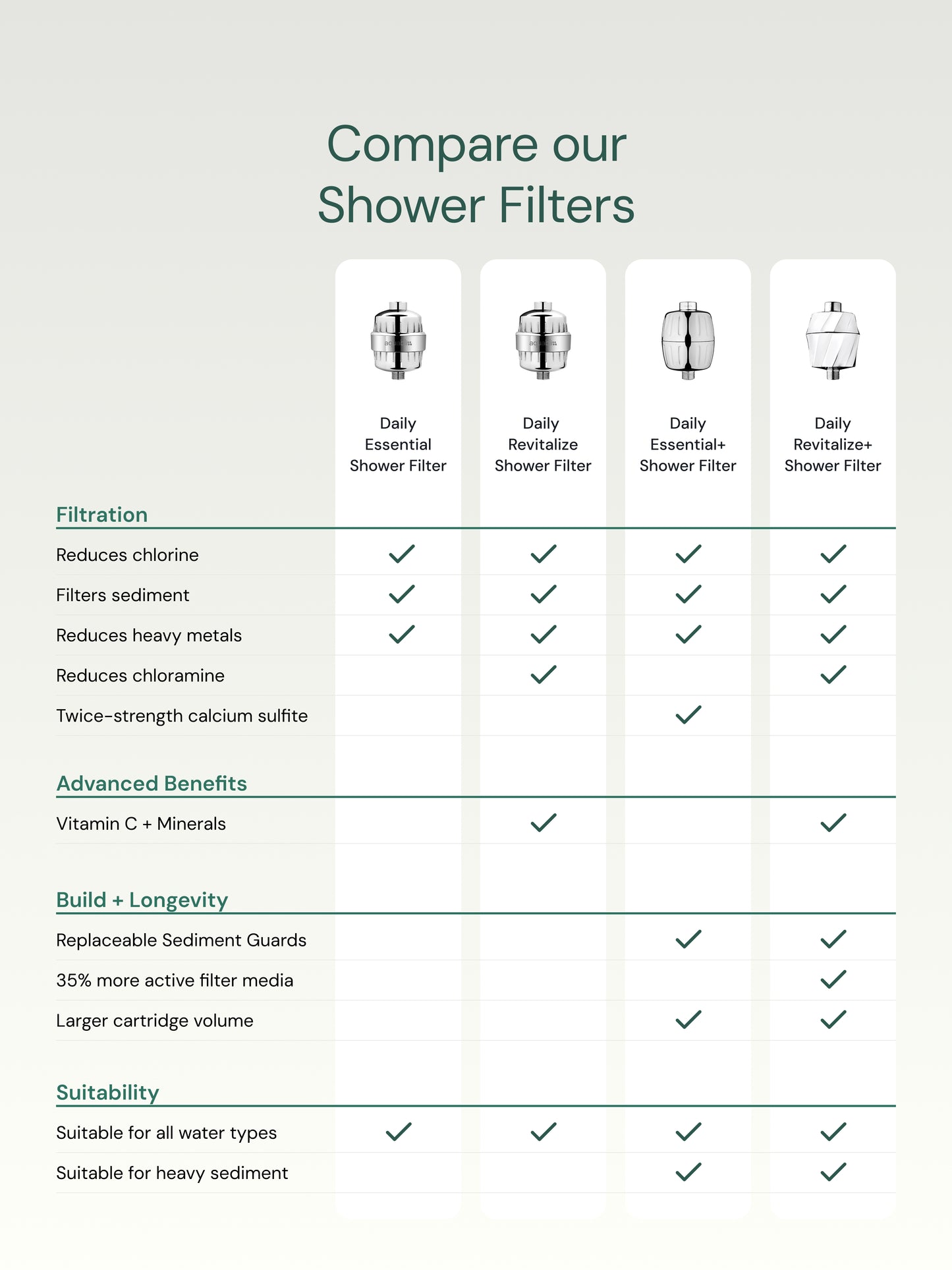
Reduces chlorine and chloramine, the disinfectants used across Alabama's public water systems.

hair icon dark green

Kinder to skin and hair

Designed with sensitive skin in mind, with fewer contaminants reaching your skin and scalp.

sediment guards icon dark green

Sediment reduction

Sediment guards trap particles that can follow storms and heavy rain.

thermometer icon dark green

Hot and cold

Filters at any temperature. Designed not to restrict flow, even on a 1.8 GPM shower head.

 Shower flow limits in Alabama

Shower flow is measured in gallons per minute (GPM): how much water leaves the showerhead each minute. Water pressure is a different measure, in pounds per square inch (PSI): the force pushing water through your pipes. A showerhead's GPM rating sets the most water it can deliver; your home's pressure decides how forceful that water feels.

Alabama follows the federal limit: new showerheads sold in the US can use no more than 2.5 GPM, measured at 80 PSI. Alabama hasn't set a stricter limit for showerheads sold in the state.

In 2025, the US Department of Energy changed how the federal limit applies to showers with several nozzles, so multi-head fixtures are no longer capped at 2.5 GPM combined. Single showerheads are still limited to 2.5 GPM.

Many showerheads use less than the legal maximum. Models with the EPA WaterSense label use 2.0 GPM or less. If your shower feels weak, the cause is usually low water pressure in your home, a clogged showerhead or a flow restrictor, rather than the flow limit itself. Your utility can tell you the typical water pressure in your area.

Is my water safe to drink?

In most cases, yes. The EPA sets national drinking water standards, and ADEM enforces them for public water systems in Alabama. Every public supplier must publish an annual Consumer Confidence Report showing where its water comes from, what it tests for and what it found.

Changes in taste, smell or mineral content don't necessarily mean water is unsafe. Older household plumbing can affect quality, though, particularly where lead pipes or fittings are present.

Private wells aren't regulated the way public systems are, so homeowners are responsible for arranging testing. The Alabama Department of Public Health recommends testing private well water regularly.

Water quality by city:

  • Huntsville
  • Birmingham
  • Montgomery
  • Mobile
  • Hoover
  • Auburn
  • Madison
  • Decatur

Closer to home, there’s also the Alabama Department of Environmental Management (ADEM), whose Drinking Water Branch regulates all the public water systems in the state.

Every public water supplier in Alabama must also publish an annual Consumer Confidence Report, which shows where its water comes from, what it tests for and what it found over the past year. It’s a well-regulated system, which is reassuring for many residents.

Despite all of this, some Alabamians still experience issues with their water quality. While it’s safe for most people, there are regional differences in taste, smell and hardness, with north Alabama tending to have harder water than the centre and coast. Older buildings may also have poorer water quality, as lead can enter from older service lines and fittings. Homes on private wells aren’t regulated in the same way as public systems, so testing is down to the homeowner.

Multi-stage filtration in 3 simple steps

We are transparent about what goes into your water so you can trust what comes out with our shower filters

01 Sediment Reduction
Filtration Diagram
01 Sediment Reduction

Your water carries more than you might think. Before it reaches your skin, our first stage catches the particles you can't see, from coarse sand and the particles associated with limescale, down to fine dust, so nothing unwanted makes it through to your shower.

Sand Filter

Ultra-fine stainless steel mesh

Micro-porous PP cotton

02 Impurity Reduction
Filtration Diagram
02 Impurity Reduction

This is where your water is truly transformed. Three powerful media work together to reduce chlorine, trihalomethanes (THMs), and other harsh chemicals, the things that leave your skin dry, your hair dull, and your nails brittle.

Calcium Sulphite

Redox Media

Activated Carbon

03 Protective Barrier
Filtration Diagram
03 Protective Barrier

A final layer of care ensures nothing escapes back into your water. Whether the cartridge is running normally or reversed, this stage keeps every captured particle and media where it belongs, inside the filter, not on your skin.

Micro-porous PP cotton

Ultra-fine stainless steel mesh


Turn ordinary water into skin-loving water

Where Alabama's water comes from

Rivers and streams: The Tennessee River supplies much of north Alabama, while the Coosa, Tallapoosa, Black Warrior and Alabama rivers serve central and southern communities. River water is treated before it reaches homes, and its quality can shift with rainfall and runoff.

Lakes and reservoirs: Reservoirs store water for public supply. Mobile relies mainly on Big Creek Lake (Converse Reservoir), fed by springs and streams in Mobile County. Birmingham draws from local reservoirs and rivers including the Cahaba. [VERIFY: Birmingham sources against the Birmingham Water Works report]

Groundwater: Wells and springs draw from underground aquifers, especially in south and southeast Alabama. Mineral levels depend on local geology, so some groundwater carries more calcium, magnesium or iron than nearby surface supplies.

Private wells: Some rural homes aren't connected to a public network. Their water quality depends on local groundwater and how well the well is maintained. Contamination isn't always visible, and it can't always be smelled or tasted.

Water across Alabama: areas and their issues


Water quality differs significantly from one part of Alabama to another. These are the areas and issues that come up most often.

  • Huntsville & Madison · Tennessee River supply, moderately hard water (around 5.8–6.5 gpg)
  • Decatur & Morgan and Lawrence counties · PFAS from historic industrial discharges into the Tennessee River; check your utility's latest PFAS results
  • Birmingham & Hoover · River and reservoir supply, including the Cahaba River and Lake Purdy [VERIFY: add hardness from the Birmingham Water Works report]
  • Montgomery & Prattville · Soft water (around 1.1–2.2 gpg)
  • Mobile · Big Creek Lake supply; the utility notified customers about PFAS detections in 2022
  • Baldwin County coast (Fairhope, Daphne, Foley) · Soft water (around 1.0–1.7 gpg)
  • Auburn & Opelika · Soft to moderately hard (around 1.7–4.3 gpg)
  • Rural south and southeast Alabama · Private wells: nitrates, naturally occurring arsenic, and bacteria after flooding

Statewide water issues

PFAS in the Tennessee River: For decades, PFAS chemicals were produced at a facility along the Tennessee River in Decatur. ADEM has reported that PFAS levels downstream have historically tested above EPA advisory levels, and the first downstream utility, West Morgan-East Lawrence Water Authority, installed advanced filtration after a 2019 settlement. PFAS levels vary by utility, so check your annual report.

Drought: Alabama has had significant dry periods, including 2000, 2007–2008 and 2011–2012. Reduced rainfall can lower rivers, reservoirs and groundwater, and may lead to water-use restrictions. [VERIFY: drought years against Drought.gov]

Heavy rain and flooding: Intense rainfall can wash sediment, fertilizers and pesticides into water sources. Flooding can also affect private wells, which should be tested before the water is used again.

Private wells: Wells don't benefit from the monitoring that public utilities carry out. Contamination from flooding, nearby septic systems or naturally occurring substances can go unnoticed without testing.

Older plumbing: Lead isn't usually present in water leaving treatment plants, but it can enter from older service lines and fittings inside a property. Your utility can tell you whether your address has a lead service line.

Alabama Water Myth Busters

How a shower filter helps

Alabama's water comes from a mix of rivers, lakes, reservoirs and groundwater, so general claims about "Alabama water" don't apply to every home. Here's what's actually true.

Myth Alabama has hard water.

Fact: Most Alabama water is soft to moderately hard. North Alabama tends to be harder, while much of central and coastal Alabama is soft.

Myth Hard water means my tap water isn't safe.

Fact: Hardness is caused mainly by calcium and magnesium. These minerals can leave limescale and affect how soap lathers, but hardness alone isn't a sign that water is unsafe.

Myth PFAS in the Tennessee River affects all Alabama water.

Fact:PFAS levels vary by utility and source. Your utility's annual report will show whether PFAS has been detected in your supply.

Myth All Alabama tap water is treated with chlorine.

Fact: Some suppliers use chlorine, and others use chloramine. Your water quality report will confirm which is used in your area.

Myth A shower filter will soften hard water.

Fact: A shower filter isn't a water softener and doesn't remove calcium or magnesium. Shower filters are designed to reduce other substances, such as chlorine, sediment or certain metals, depending on their filter media.

Myth A shower filter makes water safe after a flood.

Fact: IShower filters aren't designed for this. Follow guidance from your utility or public health authorities, and test private wells before using the water again.

Myth Well water that looks and tastes normal is safe.

Fact: Nitrates, arsenic and bacteria can't be seen, smelled or tasted. Regular testing is the only way to know.

The simple shift your skin will thank you for

No plumber, no tools needed; simply unscrew your existing shower head, twist on your Aquabliss filter, and reattach the shower head. The whole set-up process takes under 5 minutes.
Once it's on, there's nothing to think about, your Aquabliss filter works quietly in the background. When it's time for a replacement cartridge (every 3-6 months depending on your water quality), just unscrew, swap, and carry on.
Aquabliss fits any standard ½-inch shower connection — which covers the vast majority of homes in the US. It works with fixed heads, handheld, rain showers, and combo setups.
5 Stars

4.7

SF220 Daily Essential Shower Filter reviews

review image for SF100
5 / 5

Easy to install

Very easy to install. I use the SF220 shower filter and have noticed a big improvement in my hair and skin.

Michelle Verified

review image for SF100
5 / 5

Great filter

Excellent Product, Extremely Satisfied with my purchase… Highly Recommend this product for sure.

Rex Verified

review image for sf100
5 / 5

My skin was not dry at all

I tried not to use my moisturizer after shower… My skin was not dry at all.

Sakthia Verified

FAQs

Is Alabama's water hard or soft?

Mostly soft to moderately hard. The statewide median is around 3.8 grains per gallon. North Alabama, including Huntsville and Madison, tends to be harder, while Montgomery, Prattville and the Baldwin County coast are soft.

Is Alabama tap water safe to drink?

In most cases, yes. Public water is regulated by ADEM under federal Safe Drinking Water Act standards, and every utility publishes an annual water quality report.

Does my water have chlorine or chloramine?

It depends on your utility. Some Alabama systems use chlorine and others use chloramine. Your annual water quality report will say which.

Are there PFAS in Alabama water?

PFAS have been found in parts of the Tennessee River near Decatur, and some utilities elsewhere have reported detections. Levels vary by utility, so check your annual report for current results.

How often should I test my private well?

The Alabama Department of Public Health recommends regular testing, and always after flooding. Contamination isn't always visible, and it can't always be smelled or tasted.

What's the shower flow limit in Alabama?

Alabama follows the federal limit: new showerheads can use no more than 2.5 gallons per minute (GPM), measured at 80 PSI. GPM measures flow, not water pressure. Pressure is measured in PSI and varies from home to home.